Your Dream Tech Career Starts with the Right Web Development Course
Web Development Course—these three words have become one of the most searched career options among students, fresh graduates, and job seekers. The reason is simple. Every business today wants a strong online presence, and skilled web developers are the people who make that possible.Imagine two final-year engineering students, Rahul and Aman. Both graduated with similar marks and technical knowledge. Rahul spent his last six months learning practical development skills through a structured Web Development Course, built real projects, and completed an internship. Aman focused only on college academics.
Six months after graduation, Rahul was working as a Junior Web Developer at a growing startup, while Aman was still applying for jobs without much success.
What made the difference?
It wasn’t just the degree.
It was practical skills, industry exposure, and a portfolio that proved Rahul could solve real-world problems.
This story reflects what thousands of recruiters experience every year. Companies are no longer hiring candidates only because they have a degree. They want professionals who can build websites, develop applications, solve business challenges, and contribute from day one.
If you’re a college student, placement aspirant, fresher, or someone planning to switch careers, this guide will help you understand how choosing the right Web Development Course can become the turning point of your career.
Why Web Development Is One of the Best Career Choices in 2026
Technology is evolving faster than ever before.
Businesses that once relied only on physical stores now invest heavily in websites, e-commerce platforms, mobile applications, and digital services. Whether it’s a hospital, educational institute, restaurant, startup, or multinational company, every organisation needs skilled web developers.
This growing demand has created thousands of career opportunities for skilled professionals.
According to industry reports, developer roles continue to remain among the most in-demand technology careers globally. Companies are actively looking for professionals who understand modern frameworks, responsive design, databases, APIs, cloud deployment, and user experience.
For students entering the job market, this creates an exciting opportunity.
Instead of waiting for years to gain experience, learning practical development skills allows freshers to start contributing immediately.
That is why a quality Web Development Course has become much more valuable than simply learning programming theory.
Why Companies Prefer Skills Over Degrees Today
Think about how hiring has changed over the past few years.
Earlier, recruiters mainly looked at academic scores.
Today, the first question is often:
“Can you build something?”
If your answer is yes—and you can demonstrate it through projects—you already stand ahead of many applicants.
Recruiters usually evaluate candidates based on:
- Practical coding ability
- Real-world projects
- Internship experience
- Problem-solving skills
- Team collaboration
- Communication
- GitHub portfolio
- Understanding of modern tools
This is exactly why students now prefer best internship courses that combine learning with hands-on implementation instead of classroom-only education.
Practical exposure gives candidates confidence during interviews and helps them explain how they solved actual business problems.
How the Right Web Development Course Builds Your Career Step by Step
Learning web development is not just about writing HTML and CSS.
A professional program follows a structured roadmap that gradually transforms beginners into job-ready developers.
Let’s understand this journey.
Step 1: Build Strong Programming Fundamentals
Every successful developer begins with the basics.
You’ll learn:
- HTML
- CSS
- JavaScript
- Responsive Design
- Browser Fundamentals
These technologies create the foundation for every modern website.
Without mastering these basics, learning advanced frameworks becomes much more difficult.
Step 2: Learn Front-End Development
The front-end is everything users interact with.
Modern websites require attractive layouts, smooth animations, fast loading speeds, and responsive interfaces that work perfectly on mobile devices.
During this phase, students typically learn:
- Responsive UI Design
- Bootstrap
- Tailwind CSS
- React
- Component-based development
- API integration
Instead of copying tutorials, learners start creating complete websites independently.
Step 3: Master Back-End Development
Once the user interface is complete, websites need a powerful backend.
This includes:
- User authentication
- Databases
- Server-side programming
- APIs
- Security
- Performance optimisation
Popular technologies include:
- Node.js
- Express.js
- MongoDB
- SQL
- REST APIs
These skills allow developers to build complete applications instead of static websites.
Step 4: Work on Real Projects
Knowledge becomes valuable only after practical implementation.
The best students spend most of their learning time building projects such as:
- E-commerce websites
- Portfolio websites
- Hospital management systems
- Student portals
- Food delivery applications
- CRM dashboards
- Blogging platforms
Every completed project strengthens both technical skills and interview confidence.
Step 5: Internship Experience
Learning alone is not enough.
Students need exposure to real clients, deadlines, teamwork, version control, meetings, and business requirements.
This is where internship training courses provide tremendous value.
Working with experienced mentors teaches problem-solving techniques that cannot be learned from YouTube videos alone.
Many fresh graduates receive their first job offers directly after completing internships because employers already know their capabilities.
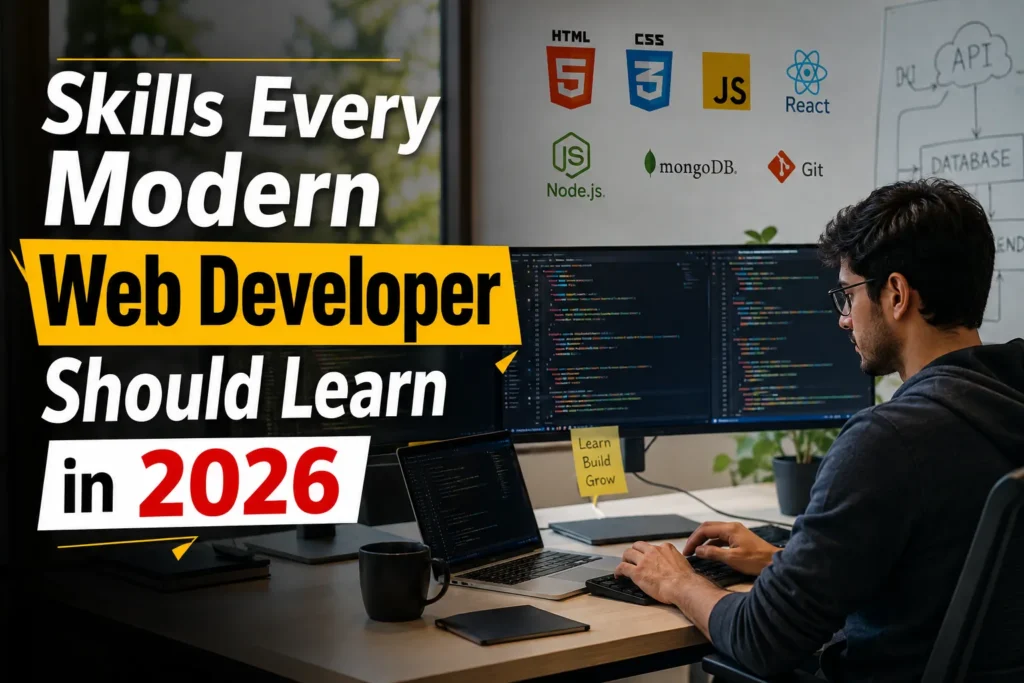
Skills Every Modern Web Developer Should Learn in 2026
Technology continues evolving rapidly.
A modern Web Development Course should include both technical and professional skills.
| Technical Skills | Professional Skills |
|---|---|
| HTML5 | Communication |
| CSS3 | Teamwork |
| JavaScript | Time Management |
| React | Problem Solving |
| Git & GitHub | Client Interaction |
| APIs | Presentation Skills |
| Node.js | Adaptability |
| MongoDB | Analytical Thinking |
| Responsive Design | Interview Confidence |
| Deployment | Continuous Learning |
Candidates who combine technical knowledge with soft skills usually perform much better during interviews.
A Real Success Story That Inspires Students
Priya graduated with a BCA degree.
Despite applying to more than 80 companies, she received very few interview calls.
The reason wasn’t her education.
She simply lacked practical experience.
Instead of giving up, Priya enrolled in a structured Web Development Course, where she learned modern technologies, built five industry-level projects, collaborated with mentors, and completed an internship.
During her interviews, she no longer answered questions theoretically.
She demonstrated her portfolio.
She explained the challenges she faced while developing applications.
discussed performance optimisation and responsive design decisions.
Within three months, she secured her first developer role.
Her journey shows that employers appreciate candidates who can demonstrate practical work instead of merely discussing concepts.
Features to Look for Before Choosing the Best Web Development Course
Not every course delivers the same value.
Before enrolling, ask yourself these questions:
✔ Does the course include live projects?
✔ Are industry mentors available?
Will I build a professional portfolio?
Is internship support included?
Are interview preparation sessions provided?
Will I learn current technologies used by companies?
Is career guidance available after course completion?
Does the curriculum include GitHub and deployment?
Are assignments based on real business scenarios?
Will I receive placement assistance?
Choosing a course with these features significantly increases your chances of becoming job-ready.
Why Practical Learning Makes a Huge Difference
Many students spend months watching tutorials.
Yet when asked to build a website independently, they struggle.
Why?
Because passive learning creates an illusion of knowledge.
Practical implementation builds confidence.
Every bug you solve teaches something new.
Every project strengthens logical thinking.
internship improves communication.
This is why many students now actively search for the best internship company in indore that offers practical training alongside mentorship.
Hands-on experience helps bridge the gap between classroom education and industry expectations.
Industry Trends That Are Shaping Web Development in 2026
Technology never stands still, and neither should developers. A modern Web Development Course should prepare you for the technologies companies are adopting today and the skills they’ll expect tomorrow.
One of the biggest trends is AI-assisted development. Tools powered by artificial intelligence help developers write code faster, detect bugs early, and automate repetitive tasks. However, these tools don’t replace developers—they make skilled developers more productive.
Another major trend is the rise of Progressive Web Apps (PWAs). Businesses want websites that feel as smooth as mobile apps while remaining accessible through a browser. This improves user experience and reduces development costs.
Cloud deployment has also become a standard expectation. Employers increasingly look for candidates who know how to deploy applications, manage hosting, and work with version control systems.
Cybersecurity awareness is equally important. Secure authentication, encrypted data, and protection against common vulnerabilities are now essential skills for every developer.
Learning these technologies during a Web Development Course helps students stay competitive in an industry that changes rapidly.
Common Mistakes Students Make While Learning Web Development
Many students begin with enthusiasm but lose direction because they follow the wrong learning approach. Recognising these mistakes early can save months of frustration.
The first mistake is constantly switching between tutorials. Watching dozens of videos without building projects creates the feeling of learning without developing real skills.
Another common mistake is ignoring JavaScript fundamentals. Many beginners rush towards frameworks like React without understanding the language itself. Strong basics always make advanced learning easier.
Students also underestimate the importance of Git and GitHub. Recruiters often review project repositories before scheduling interviews, so maintaining clean, well-documented code can leave a positive impression.
Some learners focus only on coding and neglect communication skills. During interviews, being able to explain your approach is just as important as writing the code itself.
Finally, many students skip internships. Practical exposure helps you understand client requirements, teamwork, deadlines, and debugging in real-world environments. That’s why internship training courses are becoming increasingly popular among students who want industry-ready experience.
Step-by-Step Roadmap to Become a Web Developer in 2026
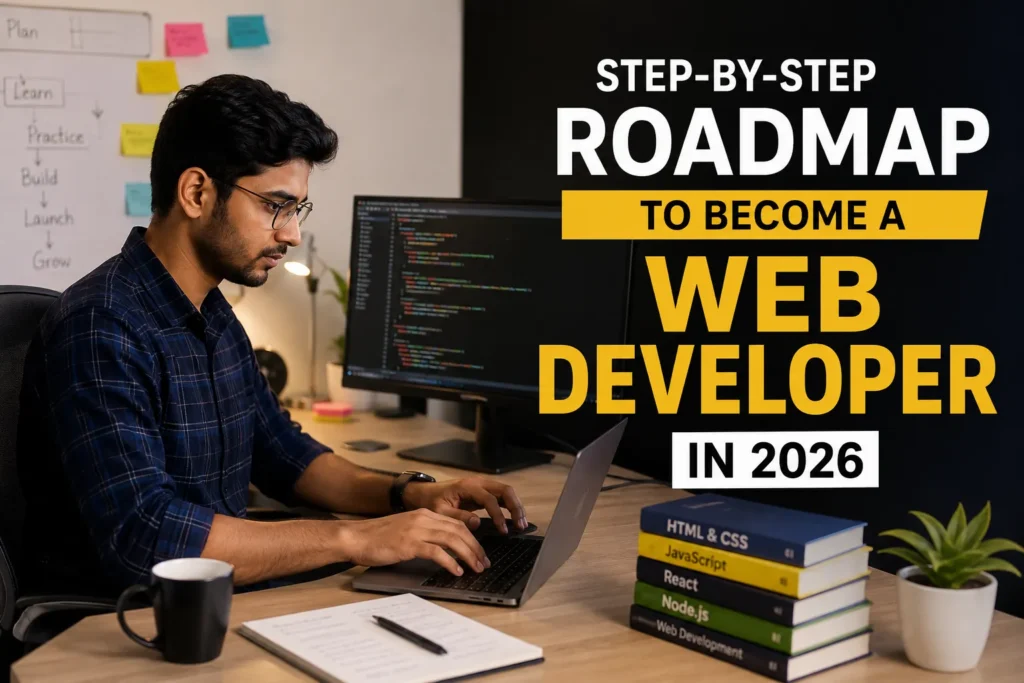
If you’re unsure where to start, follow this practical roadmap.
Step 1: Learn the Basics
Begin with HTML, CSS, and JavaScript. Understand how websites are structured, styled, and made interactive.
Step 2: Build Small Projects
Create simple websites such as:
- Personal Portfolio
- Restaurant Website
- College Event Page
- Landing Page
- Weather Application
Each project improves your confidence and problem-solving ability.
Step 3: Learn Modern Frameworks
Move to technologies like React, Node.js, Express.js, and MongoDB. These tools are widely used by startups and established companies alike.
Step 4: Create a Professional Portfolio
A portfolio should include:
- Live project links
- GitHub repositories
- Project descriptions
- Technologies used
- Challenges solved
Employers often evaluate portfolios before reviewing resumes.
Step 5: Complete an Internship
Practical learning through best internship courses gives you real industry exposure. Working on client-based projects helps you understand professional workflows and prepares you for full-time roles.
Step 6: Prepare for Interviews
Practice coding challenges, revise core concepts, and learn to explain your projects confidently. Mock interviews can help identify areas for improvement.
Case Study: How Practical Training Changed a Career
Arjun, a final-year B.Tech student, had a strong academic record but struggled with technical interviews because he lacked hands-on experience.
Instead of applying to hundreds of jobs immediately, he focused on improving his practical skills. He enrolled in a Web Development Course, completed multiple full-stack projects, participated in code reviews, and worked on real client assignments during an internship.
By the end of the programme, he had:
- Six portfolio projects
- An active GitHub profile
- Internship experience
- Improved communication skills
- Confidence during technical interviews
Within weeks of completing his training, Arjun secured a role as a Junior Full-Stack Developer.
His success highlights an important lesson: consistent practice often matters more than theoretical knowledge alone.
Comparing Different Learning Options
| Learning Method | Practical Experience | Mentor Support | Portfolio Building | Career Support |
|---|---|---|---|---|
| Free Tutorials | Limited | No | Limited | No |
| Recorded Courses | Moderate | Limited | Partial | Rare |
| College Curriculum | Basic | Moderate | Limited | Limited |
| Professional Web Development Course | Extensive | Yes | Strong | Yes |
A structured learning environment helps students stay accountable and develop skills aligned with current industry expectations.
Why Internships Matter More Than Ever
Employers want candidates who can contribute from the first day. Internship experience demonstrates that you’ve worked on real projects, collaborated with teams, and adapted to professional environments.
At organisations like The Internspire, students have the opportunity to combine structured learning with practical implementation. This approach allows learners to apply classroom concepts to real business challenges, strengthening both technical and professional skills.
For students in Madhya Pradesh, exploring opportunities such as best internship company in indore can provide valuable exposure while building a strong portfolio.
Similarly, learners interested in expanding their digital skill set may also explore programmes like digital marketing course in indore, digital marketing training in indore, digital marketing classes in indore, or the top digital marketing institute in indore if their career goals include both development and digital growth. Combining technical development with marketing knowledge can be particularly valuable for startups, freelancers, and entrepreneurs.
Quick Checklist Before You Enrol
Before choosing a Web Development Course, make sure it offers:
- Updated curriculum aligned with industry standards
- Hands-on projects
- Internship opportunities
- Experienced mentors
- Interview preparation
- Portfolio development
- GitHub guidance
- Resume building support
- Placement assistance
- Lifetime learning resources or alumni support
If a programme covers these areas, you’re more likely to graduate with the confidence employers are looking for.
Actionable Tips to Stand Out From Other Freshers
Building technical skills is only part of the journey. To increase your chances of getting hired:
- Build at least five complete projects instead of dozens of unfinished ones.
- Push your code regularly to GitHub with meaningful commit messages.
- Learn how to explain your code during interviews.
- Contribute to open-source projects when possible.
- Keep your LinkedIn profile updated with certifications and project links.
- Practice aptitude and technical interview questions consistently.
- Continue learning as technologies evolve.
Small, consistent improvements can make a significant difference over time.
Frequently Asked Questions
Is a Web Development Course suitable for beginners?
Yes. Most structured programmes start with the fundamentals before progressing to advanced topics, making them suitable for students and fresh graduates.
How long does it take to become job-ready?
The timeline depends on your dedication and practice. Many learners develop job-ready skills within a few months through consistent learning, project work, and internships.
Do I need a computer science degree?
No. Many successful developers come from non-technical backgrounds. Practical skills, projects, and problem-solving ability are often more important than the degree itself.
Which programming language should I learn first?
JavaScript is an excellent starting point because it is widely used for both front-end and back-end development.
Can internships improve placement opportunities?
Absolutely. Internship experience demonstrates practical ability, teamwork, and real-world problem-solving, making candidates more attractive to employers.
Is web development still a good career in 2026?
Yes. As businesses continue to invest in digital products and online services, demand for skilled developers remains strong across startups, agencies, and enterprise organisations.
Final Thoughts
Choosing the right Web Development Course is more than enrolling in a training programme—it’s an investment in your future. The technology industry rewards people who can solve problems, build useful products, and continue learning throughout their careers.
If you’re a final-year student, fresher, internship seeker, or career starter, don’t wait for the “perfect” opportunity. Start building your skills today. Every project you complete, every challenge you overcome, and every practical lesson you learn brings you one step closer to your first tech job.
At The Internspire, the focus is on helping learners bridge the gap between academic knowledge and industry expectations through practical learning, mentorship, and career-focused training. Whether your goal is to secure internships, prepare for campus placements, or begin a rewarding career in technology, taking action today can shape the opportunities you receive tomorrow.
Your tech career doesn’t begin after graduation—it begins with the decision to start learning today.