
The Skill That Could Make Your Resume Stand Out in 2026
Semantic SEO is rapidly becoming one of the most valuable digital skills in today’s job market. While many students are still learning traditional SEO techniques, recruiters are actively searching for candidates who understand how Google AI interprets content, user intent, topics, and entities rather than just keywords.
Imagine two graduates applying for the same digital marketing role.
The first candidate knows how to add keywords to a webpage.
The second candidate understands Semantic SEO, search intent, topical authority, AI-powered search results, and content optimization for Google’s latest algorithms.
Who do you think gets shortlisted first?
In most cases, the second candidate wins.
As Google continues shifting toward AI-powered search experiences, businesses need professionals who can help websites remain visible. This growing demand has created exciting opportunities for students, fresh graduates, internship seekers, and career starters.
If you’re searching for a future-proof skill that combines creativity, technology, content strategy, and AI, this guide is for you.
What Is Semantic SEO?
Semantic SEO is the practice of creating content that helps search engines understand the meaning, context, relationships, and intent behind a topic.
Instead of focusing on one keyword repeatedly, Semantic SEO focuses on answering related questions, covering connected topics, and providing comprehensive information.
Traditional SEO vs Semantic SEO
| Traditional SEO | Semantic SEO |
|---|---|
| Focuses on exact keywords | Focuses on topic understanding |
| Keyword density driven | User intent driven |
| Single-page optimization | Topic cluster optimization |
| Limited content depth | Comprehensive content coverage |
| Rankings focused | User experience focused |
Google’s AI systems now analyze:
- User intent
- Topic relevance
- Entity relationships
- Contextual meaning
- Content quality
- Experience and expertise
This shift is why Semantic SEO has become one of the fastest-growing skills in digital marketing.
Why Recruiters Are Looking for Semantic SEO Skills
Recruiters understand that search engines have changed dramatically.
Businesses need professionals who can adapt to:
- Google AI Search
- AI Overviews
- Search Generative Experiences
- Voice Search
- Conversational Search Queries
A recent trend across digital marketing agencies shows increasing demand for SEO professionals who understand content strategy and search intent rather than keyword stuffing.
Companies are no longer asking:
“Can you write a blog?”
They are asking:
“Can you create content that ranks in AI-powered search results?”
That’s where Semantic SEO becomes valuable.
The Story of Rahul: From Graduate to SEO Professional
Rahul graduated with an average academic record.
He applied for more than 100 jobs.
Most applications received no response.
Instead of waiting, Rahul joined a digital marketing course in indore and started learning modern SEO techniques.
He focused on:
- Search intent
- Content clusters
- Semantic optimization
- Internal linking
- AI-driven content strategies
Within six months, Rahul secured an internship.
Today, he works with international clients and earns significantly more than many fresh graduates in traditional entry-level roles.
His turning point wasn’t a degree.
It was learning a skill aligned with industry demand.
Semantic SEO and the Rise of Google AI
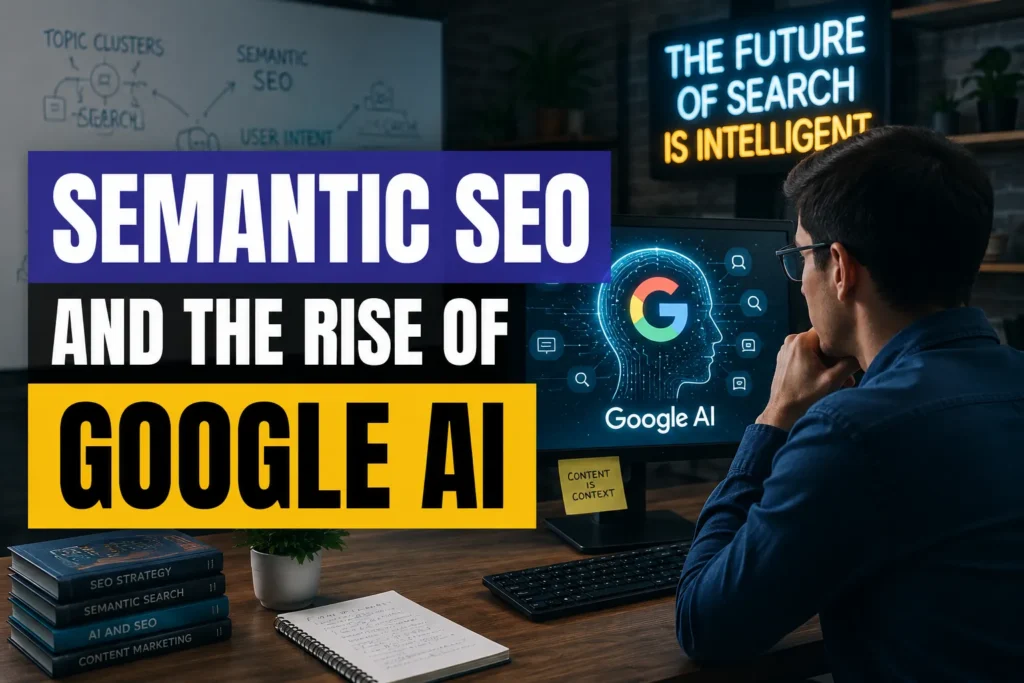
Google processes billions of searches every day.
Many searches are conversational.
Examples:
- Which digital marketing skills are best in 2026?
- How can students get digital marketing internships?
- What skills do recruiters want?
Google now tries to understand the meaning behind these questions.
This is why websites optimized using Semantic SEO often perform better than websites relying solely on keywords.
How Google Understands Topics
Google connects:
- People
- Organizations
- Places
- Skills
- Industries
- Concepts
These connections help search engines provide better answers.
Students who understand this process become valuable assets to businesses.
Semantic SEO Skills Recruiters Value Most
1. Search Intent Analysis
Understanding what users truly want.
2. Topic Clustering
Creating content around a complete subject.
3. Content Strategy
Planning content that answers multiple related questions.
4. Entity Optimization
Helping search engines understand relationships between concepts.
5. Internal Linking
Building strong content networks.
6. AI Search Optimization
Preparing content for AI-generated search experiences.
Semantic SEO Career Opportunities for Students
Learning Semantic SEO can open doors to multiple career paths.
Popular Roles
- SEO Executive
- Content Strategist
- Digital Marketing Executive
- SEO Analyst
- AI Search Specialist
- Content Marketing Specialist
- Organic Growth Associate
- SEO Consultant
Many of these positions are accessible through:
- internship institute near me
- internship training in indore
- paid internship in indore
- internship with certificate in indore
These opportunities help students gain practical experience before graduation.
Case Study: Small Business Growth Through Semantic SEO
A local training institute struggled to generate website traffic.
Their blogs targeted only individual keywords.
After implementing Semantic SEO:
Before
- 3,000 monthly visitors
- Low engagement
- Limited rankings
After
- 18,000 monthly visitors
- Higher engagement
- More leads
- Better search visibility
What changed?
The content strategy focused on:
- User questions
- Related topics
- Internal links
- Topic clusters
- Search intent
The result was significant organic growth.
Step-by-Step Semantic SEO Learning Roadmap
Step 1: Learn SEO Fundamentals
Understand:
- Keywords
- On-page SEO
- Technical SEO
- Link building
Step 2: Master Search Intent
Identify whether users want:
- Information
- Comparison
- Purchase
- Navigation
Step 3: Build Topic Clusters
Example:
Main Topic:
Semantic SEO
Supporting Topics:
- AI SEO
- Search Intent
- Topical Authority
- Content Clusters
- Entity SEO
Step 4: Practice Content Writing
Create articles regularly.
Step 5: Work on Real Projects
Join:
- best internship company in indore
- courses with internship in indore
- digital marketing training near me
Step 6: Build a Portfolio
Showcase:
- Blog projects
- SEO audits
- Keyword research
- Ranking improvements
Semantic SEO Success Story: A Student’s Journey
Priya was a final-year student.
She had no work experience.
Most recruiters ignored her applications.
Instead of giving up, she enrolled in a digital marketing course in indore and focused on Semantic SEO.
Within four months:
- Completed SEO projects
- Built a personal blog
- Earned certifications
- Secured internship experience
Today, she receives interview calls regularly because recruiters value practical skills.
Semantic SEO Industry Trends for 2026
AI Search Expansion
Google AI continues transforming search experiences.
Voice Search Growth
Users increasingly ask conversational questions.
Content Depth Matters
Comprehensive content outperforms shallow articles.
User Intent Becomes Critical
Understanding users becomes more important than counting keywords.
Topical Authority Wins
Websites covering entire subjects gain stronger rankings.
Common Semantic SEO Mistakes Students Make
Mistake 1: Keyword Stuffing
Repeating the same keyword excessively.
Solution
Write naturally.
Focus on topic coverage.
Mistake 2: Ignoring User Intent
Ranking becomes difficult when content doesn’t solve problems.
Solution
Understand audience needs first.
Mistake 3: Weak Internal Linking
Disconnected content reduces authority.
Solution
Link related articles strategically.
Mistake 4: Thin Content
Short articles often fail to satisfy search intent.
Solution
Create comprehensive resources.
Semantic SEO Checklist for Students
Learn keyword research
Understand search intent
Create topic clusters
Improve content quality
Build internal links
Study Google AI updates
Practice writing regularly
Create a portfolio website
Complete certifications
Gain internship experience
How Semantic SEO Supports Campus Placements
Recruiters increasingly prioritize skills over degrees.
Students with practical knowledge stand out.
Particularly when they possess experience from:
- placement training institute in indore
- job oriented courses in indore
- best skill development institute in indore
- courses with internship in indore
These experiences demonstrate industry readiness.
Expert Insights
Industry professionals consistently highlight one trend:
SEO is no longer just about keywords.
It is about understanding people.
Search engines want to deliver the best answer.
Businesses need professionals who can create that answer.
Students who develop these skills position themselves ahead of the competition.
Interactive Questions for Self-Assessment
Ask yourself:
- Can I identify user intent?
- Do I understand Google’s AI search evolution?
- Can I create topic clusters?
- Have I completed practical projects?
- Do I have internship experience?
- Can I demonstrate SEO results?
If most answers are “No,” now is the perfect time to start learning.
Frequently Asked Questions About Semantic SEO
What is Semantic SEO in simple words?
It helps search engines understand the meaning and context of content rather than relying only on keywords.
Is Semantic SEO difficult to learn?
No. Students can learn it gradually through practice and real-world projects.
Does Semantic SEO have career opportunities?
Yes. Demand continues growing in digital marketing, content marketing, and AI search optimization.
Can freshers get jobs using Semantic SEO skills?
Absolutely. Many companies hire freshers who demonstrate practical SEO knowledge.
Is SEO still relevant in the AI era?
More than ever. AI-powered search increases the importance of understanding topics and user intent.
Which course is best for learning SEO?
Look for practical programs offering hands-on projects, internships, and industry exposure.
The Future Belongs to Students Who Learn High-Income Skills
The job market is changing rapidly.
Degrees alone no longer guarantee opportunities.
Employers want candidates who can solve real business problems.
Semantic SEO sits at the intersection of technology, AI, content strategy, and digital marketing.
For final-year students, fresh graduates, internship seekers, and career starters, this skill offers a practical path toward career growth.
The earlier you start, the greater your competitive advantage becomes.
Whether you’re searching for an internship near me, exploring a digital marketing course in indore, looking for an internship with certificate in indore, seeking a paid internship in indore, or joining a best skill development institute in indore, learning Semantic SEO can help you build a stronger future.
Ready to Future-Proof Your Career?
At TheInternspire, students gain practical exposure, industry-relevant training, and hands-on experience designed to bridge the gap between education and employment.
Start building the skills recruiters are actively seeking.
Your next internship, job opportunity, or career breakthrough could begin with mastering Semantic SEO today.