What If Your Hard Work Is Invisible Online?
You create a website, publish useful content, and wait for visitors. Days pass, but almost nobody finds it. This is where Search Engine Optimization becomes important. SEO helps search engines understand your content and helps the right people discover it when they search for something you offer.
Think about a student who creates a portfolio after learning digital marketing. The portfolio looks great, but when someone searches for a relevant service, it does not appear anywhere near the first page. The problem may not be the quality of the work. The real issue could be that search engines cannot clearly understand, trust, or prioritize the page.
For students and fresh graduates, learning SEO is more than understanding keywords. It teaches you how websites work, how people search, how content attracts visitors, and how businesses compete online. These skills can become useful whether you are preparing for an internship, applying for your first job, or building your own online project.
If you are exploring a digital marketing course in Indore, practical SEO should be one of the skills you pay attention to. Reading theory is helpful, but actually optimizing a webpage, checking its performance, studying competitors, and improving content is where the real learning begins.
Search Engine Optimization: What Does It Actually Mean?
In simple words, SEO is the process of improving a website so that search engines can understand it better and users can find it through relevant searches.
Suppose a person searches for “digital marketing internship in Indore.” Search engines need to decide which pages are useful enough to show. They consider many signals, including relevance, content quality, website structure, usability, links, and other factors.
That does not mean you can simply repeat “digital marketing internship in Indore” twenty times and expect a top position. Modern SEO is about creating genuinely useful content while making the page easy for both users and search engines to understand.
For a beginner, it is useful to think about SEO through four simple areas: content, technical health, authority, and user experience.
Good content answers the searcher’s question. Technical SEO makes the website accessible and understandable. Authority helps establish credibility. User experience makes visitors more likely to stay, explore, and take action.
Why Search Engine Optimization Matters for Students and Freshers
Imagine two graduates applying for the same digital marketing role.
One graduate says, “I know SEO.”
The second says, “I researched keywords, optimized a landing page, improved title tags, created internal links, analyzed competitors, and monitored rankings.”
The second candidate has something valuable: practical experience.
This is why SEO can be an attractive skill for Final-Year Students, Fresh Graduates, Internship Seekers, Job Seekers (Freshers), and Campus Placement Aspirants. It gives learners an opportunity to work on measurable activities instead of only collecting theoretical knowledge.
Students researching best internship courses should also look for programs that allow them to work on actual websites or projects. A practical project can give you something meaningful to discuss during an interview.
The same applies when comparing internship training courses. Ask whether the training includes keyword research, on-page optimization, content planning, technical basics, analytics, reporting, and real project work.
How Search Engine Optimization Helps a Website Rank Better
Ranking is not controlled by one magic trick. Search engines evaluate pages using many systems and signals, and the exact algorithms are constantly changing.
A practical SEO process usually starts with understanding search intent.
Search intent means understanding what the user actually wants. Someone searching “what is SEO” probably wants information. searching “SEO internship in Indore” may be looking for an opportunity. Someone searching “best digital marketing institute in Indore” is closer to making a decision.
When your content matches that purpose, it becomes more useful.
The next step is creating content that completely addresses the topic. Instead of writing 500 words just to target a keyword, answer the questions a real reader would have.
Your page structure also matters. A clear title, useful headings, descriptive URLs, relevant internal links, readable paragraphs, optimized images, and helpful navigation can create a better experience.
A Practical Search Engine Optimization Process for Beginners
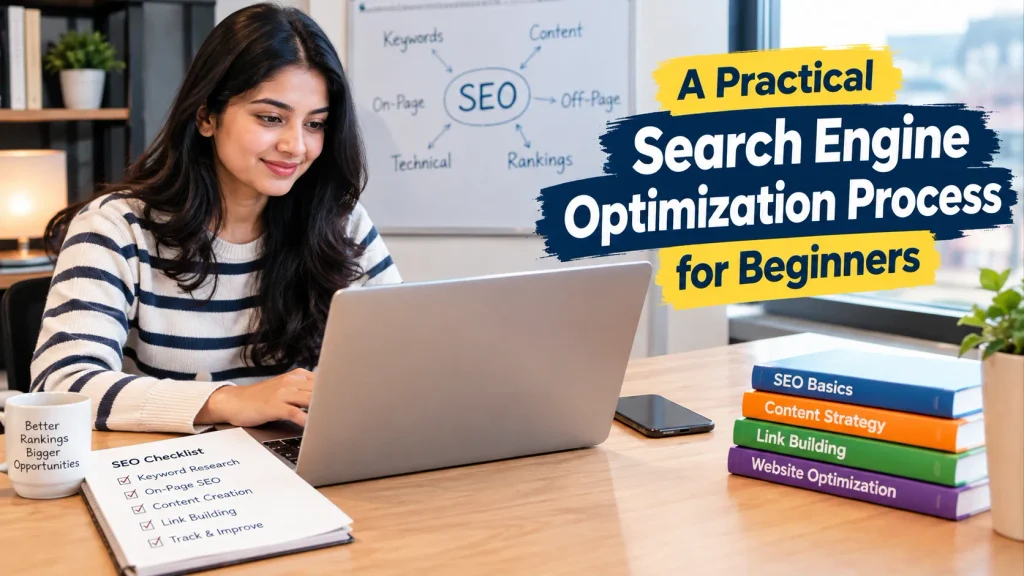
Start With Keyword and Search Intent Research
Do not begin by writing random content.
First, identify what your target audience searches for. For example, a student interested in digital marketing might search for digital marketing training in Indore, digital marketing classes in Indore, internship opportunities, course comparisons, career paths, or placement-related information.
Look at the wording behind these searches. Are people trying to learn something, compare options, find a local institute, or take an action?
Your primary keyword should fit naturally into the topic. Supporting keywords should help cover related search needs rather than making the article sound repetitive.
Build Content Around a Real Question
A strong SEO article should feel like it was written for a person, not an algorithm.
Instead of writing:
“SEO is important. helps websites rank. SEO improves visibility.”
Create a useful explanation, example, and solution around the subject.
For example, if your audience is a college student, explain SEO using a college website, internship listing, personal portfolio, or small business website. Familiar situations make technical concepts easier to understand.
Optimize the Important On-Page Elements
Your page title should clearly explain what the page is about.
The main heading should match the topic. Subheadings should break large ideas into manageable sections. Images should have descriptive alternative text. Internal links should guide visitors toward related content.
Use the target phrase naturally instead of inserting it wherever possible.
A student learning through the top digital marketing institute in Indore should be able to apply these principles to a practice website rather than simply memorize definitions.
Improve the Technical Side
Technical SEO can sound complicated, but beginners can start with basic checks.
Make sure important pages can be crawled and indexed. Check whether the website works well on mobile devices. Avoid broken links and confusing navigation. Improve slow pages where possible. Use HTTPS and maintain a clean site structure.
Search engines also care about page experience, so a website that is difficult to use can create problems even when its content is good.
Create Internal Links
Internal links connect relevant pages on the same website.
Imagine a blog about SEO that discusses keyword research. It could naturally link to another article explaining content marketing, keyword mapping, or digital marketing careers.
This helps users discover more information while giving search engines additional context about the relationship between pages.
Earn Relevant Backlinks
Backlinks are links from other websites to your website.
However, getting hundreds of random links is not the goal. A relevant and trustworthy link can be more valuable than a large collection of low-quality links.
For a student portfolio, for example, links from a college project page, professional profile, industry publication, or relevant educational resource may make more sense than unrelated websites.
Real-Life Example: Turning an Invisible Page Into a Useful Resource
Consider a fictional student named Rahul who has completed digital marketing training and wants to attract internship opportunities.
He creates a page titled “My Digital Marketing Skills.” The page contains a short introduction and a list of tools he knows.
After learning SEO, Rahul changes his approach.
He creates separate sections for SEO, content marketing, social media, analytics, and project experience. He adds useful examples of work, improves the page title, writes a clear introduction, connects relevant pages, and publishes helpful articles around the skills he has learned.
The page is no longer just a resume online. It becomes a useful resource that demonstrates his knowledge.
This does not guarantee rankings or employment. However, it gives Rahul a stronger digital presence and a better portfolio to discuss with recruiters.
A Simple SEO Case Study You Can Try Yourself
Take a small website with ten blog articles.
Imagine that five articles receive almost no organic traffic. Instead of publishing ten more articles, analyze those five pages.
Check the search intent. Improve outdated information. Rewrite unclear sections. Add relevant FAQs. Strengthen internal linking. Improve titles and descriptions. Remove unnecessary repetition. Add useful visuals.
After making changes, monitor impressions, clicks, rankings, and engagement over time.
This approach teaches an important SEO lesson: improving existing content can sometimes be more useful than constantly creating new content.
For Skill Development Learners, this type of exercise is especially valuable because it turns SEO into a practical problem-solving activity.
Search Engine Optimization vs Paid Search
SEO and paid search can both bring visitors, but they work differently.
| SEO | Paid Search |
|---|---|
| Focuses on organic visibility | Uses paid advertising |
| Can build long-term visibility | Can generate traffic quickly |
| Requires content and technical improvement | Requires advertising budget |
| Results can take time | Results can start after campaigns launch |
| Strong focus on relevance and website quality | Strong focus on targeting and ad performance |
A smart digital marketer should understand both rather than treating them as competing concepts.
This is one reason learners comparing the best digital marketing institute in Indore should look beyond course names. A useful program should explain how SEO connects with paid advertising, content, social media, analytics, and broader digital marketing.
SEO Mistakes Beginners Should Avoid
Keyword Stuffing
Repeating the same phrase excessively can make content difficult to read.
Write for humans first. Use related terms and natural language where they genuinely fit.
Writing Without Search Intent
A page can contain excellent information and still fail to satisfy the person searching.
Always ask: “What does the reader expect after typing this query?”
Copying Competitors
Competitor research is useful, but copying their structure or wording does not create original value.
Study what they cover and identify what they have missed. Then provide a clearer or more useful answer.
Ignoring Existing Content
Some websites publish hundreds of articles but rarely review old ones.
Regular content audits can reveal pages that need updates, better links, clearer answers, or stronger titles.
Expecting Instant Rankings
SEO is not an overnight process.
A new website may need time to build content, authority, trust, and search visibility. Track progress using impressions, clicks, rankings, conversions, and other meaningful metrics.
Learning Only Through Theory
Watching tutorials for months without touching a website can create false confidence.
Build something. Break something. Fix it. Test a title. Improve a page. Analyze the results.
That is how knowledge becomes a skill.
Industry Trends Every Beginner Should Understand
SEO continues to change as search behavior, technology, and search interfaces evolve.
Artificial intelligence is influencing how people discover and consume information. Search experiences are becoming more conversational, while users increasingly expect direct and useful answers.
This makes original expertise, first-hand experience, useful examples, strong content structure, and trustworthy information increasingly important.
Local search also remains highly relevant for businesses. Someone searching for the best digital marketing course in Indore has a different need from someone searching for “how does SEO work?”
Understanding this difference can help you create better pages for specific audiences.
For career starters, learning how to combine SEO with AI tools, analytics, content creation, and conversion optimization can create a broader digital marketing skill set.
Build Your Own SEO Practice Project
You do not need to wait for your first job to start building experience.
Create a simple website or portfolio. Choose one topic. Research relevant queries. Publish useful content. Optimize your pages. Add internal links. Study competitors. Track performance.
If you are considering a digital marketing internship in Indore, use your practice project as evidence of your ability.
During an interview, instead of simply saying “I completed an SEO course,” you can explain what you worked on and what you learned.
That difference can make your conversation much stronger.
Search Engine Optimization Checklist for Beginners
Before publishing an important page, ask yourself a few practical questions.
Is the main topic clear within the first few lines? Does the content satisfy the search intent? Is the primary phrase used naturally? Are related topics covered without repetition? Does the title accurately describe the page?
Then check the technical side. Is the page mobile-friendly? Are important internal links included? Are images optimized? Is the URL simple? Can search engines access and index the page?
Finally, read the article like a visitor.
Would you actually find this useful?
If the answer is no, improve the content before worrying about rankings.
Five Actionable SEO Tips You Can Start Today
1: Choose one real website and optimize one page instead of reading another ten tutorials.
2: Search your target query and study the type of content appearing on the first page.
3: Rewrite one old article by improving its usefulness rather than simply adding more words.
4: Create an internal linking map between related articles.
5: Track your changes and results so you understand what actually works.
These small activities can become excellent portfolio material for students applying for internship training courses or entry-level digital marketing roles.
Interactive Question: What Would You Optimize First?
Imagine you receive a website with good content but almost no organic traffic.
What would you check first?
Would you investigate keywords and search intent? you check technical problems? Would you improve the content? Would you look at backlinks?
There is no need to choose only one forever. SEO works best when you learn to investigate the complete picture.
Try this exercise on your own website and write down three problems you discover. Then solve them one at a time.
A Practical Learning Path for Your SEO Career

If you are a College Student, begin with fundamentals such as search intent, keywords, on-page SEO, content structure, internal linking, and basic technical SEO.
As a Fresh Graduate, move toward practical projects, analytics, competitor research, local SEO, reporting, and content strategy.
As an Internship Seeker, focus on demonstrating your work. Build sample audits, optimized pages, content briefs, keyword research sheets, and project reports.
For Job Seekers (Freshers), connect SEO with broader skills such as Google Analytics, Search Console, content marketing, paid advertising, social media, and conversion optimization.
If you are comparing best internship company in Indore options, look for opportunities where you can work on genuine projects, understand the reason behind tasks, receive feedback, and build measurable experience.
Success Story: From Learning SEO to Showing Skills
A common problem among freshers is having certificates without practical examples.
Suppose a graduate spends three months learning SEO and then creates a mini project around a local business. The graduate researches search terms, analyzes competitors, optimizes five pages, improves internal linking, creates a content plan, and documents the process.
Even without years of professional experience, that candidate now has a story to tell.
The project demonstrates curiosity, analysis, execution, and learning.
That is the real value of Search Engine Optimization as a career skill.
Learn Practical SEO, Not Just Definitions
SEO becomes easier when you stop treating it as a collection of technical terms.
Think about the person searching. Understand the problem. Create the best useful answer you can. Make the website easy to access. Connect related information. Measure what happens. Then improve.
If your goal is to enter digital marketing, choosing the best digital marketing course in Indore should involve looking at practical exposure, live projects, mentorship, tools, and career-oriented learning rather than focusing only on certificates.
The Internspire can be a starting point for learners who want to develop practical digital marketing skills and understand how SEO fits into a larger career path.
Whether you are preparing for an internship, campus placement, your first job, or a freelance career, start with one project and keep improving it.
Your first SEO project does not have to be perfect. It just needs to begin.
Frequently Asked Questions
What is Search Engine Optimization in simple words?
Search Engine Optimization is the process of improving a website so search engines can understand its content and users can discover it through relevant organic searches.
Is SEO difficult for beginners?
SEO can feel technical at first, but the fundamentals are approachable. Start with search intent, keyword research, on-page optimization, content quality, internal linking, and basic technical concepts.
Can students learn SEO without experience?
Yes. Students can practice by creating a small website, optimizing sample pages, conducting keyword research, and analyzing search results. Practical projects are useful for building confidence.
Is SEO useful for getting a digital marketing job?
Yes. SEO is one part of digital marketing and can be useful for roles involving content, organic search, website optimization, local SEO, and digital strategy.
Should I learn SEO before joining an internship?
You do not need to master everything first. Understanding the basics before an internship can help you learn faster, while practical internship work can develop your skills further.
What should I look for in a digital marketing training program?
Look for practical projects, experienced guidance, SEO tools, analytics, content work, campaign exposure, assignments, feedback, and opportunities to apply what you learn.
Is SEO better than paid advertising?
Neither is universally better. SEO focuses on organic visibility, while paid advertising can provide immediate exposure through advertising budgets. Businesses often benefit from understanding both.
How long does it take to learn SEO?
You can learn the fundamentals in a few weeks, but becoming proficient requires continuous practice. SEO changes over time, so experienced professionals keep learning and testing.
Start Your SEO Journey With a Real Project
The best way to understand SEO is to apply it.
Choose a website, select one page, identify its search intent, improve the content, optimize the page, add relevant internal links, and monitor the results.
If you are looking for digital marketing training in Indore, digital marketing classes in Indore, or a practical path toward a digital marketing career, make sure your learning goes beyond theory.
Learn. Practice. Analyze. Improve. Repeat.
That simple cycle can turn SEO knowledge into a skill you can confidently demonstrate to employers, internship providers, and clients.