When Students Search for Careers, Will AI Recommend You?
AI Search Optimization is changing the way people discover courses, internships, training institutes, and career opportunities online. A student no longer needs to search only for “digital marketing course” and compare ten blue links. They can now ask an AI-powered search tool a much more specific question such as, “Which is the best digital marketing course in Indore for a fresher who wants practical experience?”
That change matters for students and training institutes alike.
Imagine a final-year student sitting at home and asking an AI search engine to recommend a course that includes practical projects, internship experience, certification, and placement support. The answer may mention a few websites, institutes, courses, or resources. The real question is simple: what makes one website more likely to be understood, trusted, and recommended by AI?
This is where modern SEO meets AI-powered search.
Google explains that its AI search experiences, including AI Overviews and AI Mode, still rely heavily on its core Search systems. Google also emphasizes helpful, original, people-first content rather than special “AI hacks.”
For students, this means learning how search is changing can become a career advantage. For education and training websites, it means creating content that genuinely answers people’s questions is becoming more important than simply repeating keywords.
What Is AI Search Optimization?
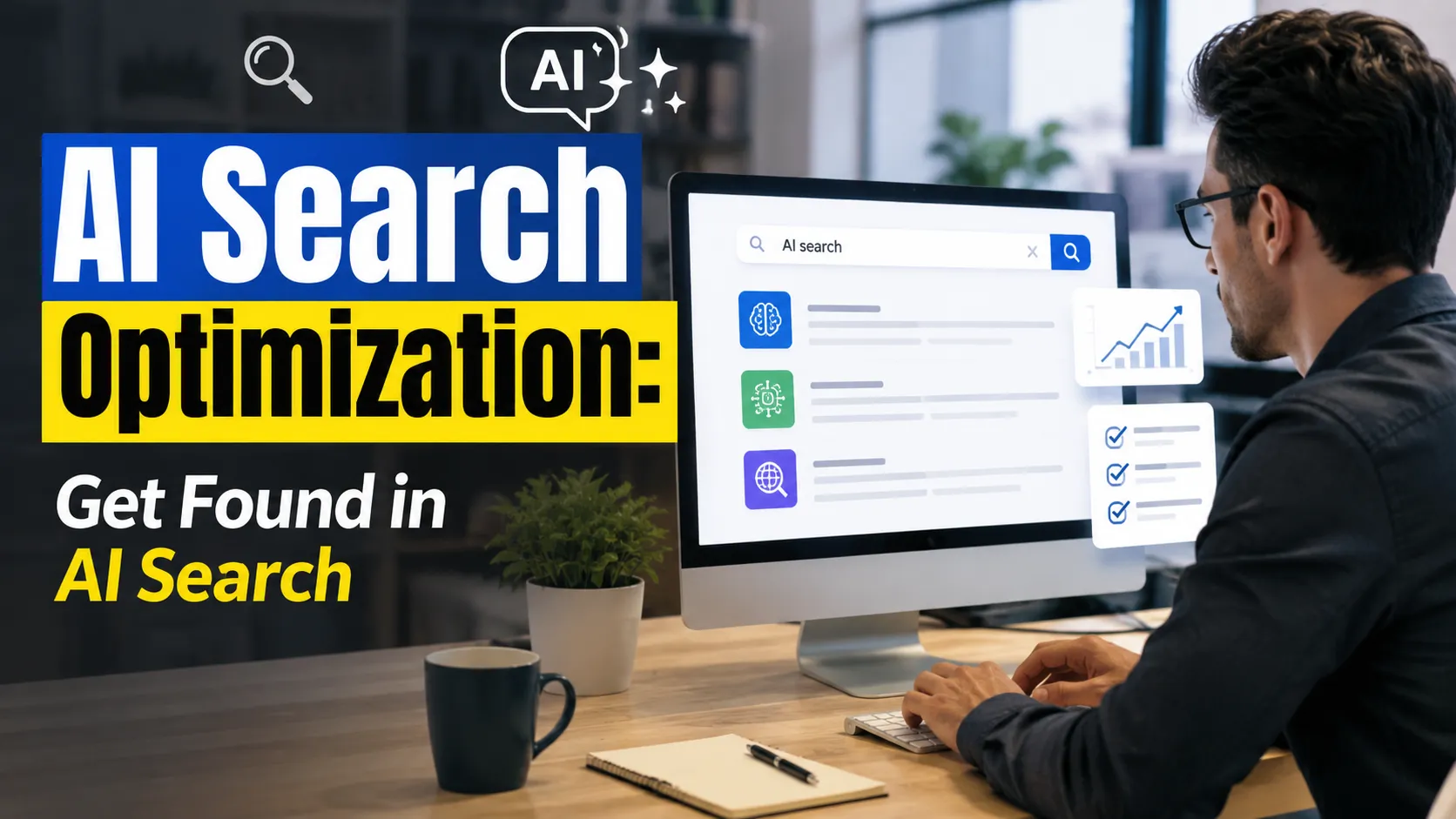
AI Search Optimization is the process of creating and improving website content so that AI-powered search experiences can understand the information, connect it with user questions, and potentially surface the website as a useful source.
Traditional SEO often focuses on ranking for searches such as “digital marketing course in Indore.”
AI-powered search can involve much longer questions.
For example, a student may ask:
“Where can I learn digital marketing in Indore with internship experience and practical projects?”
The search engine has to understand the student’s intent, identify relevant information, compare sources, and provide a useful response.
That means your website needs more than a keyword. It needs clear answers, useful information, credibility, good structure, and a strong connection between the content and the audience’s actual needs.
Google’s current guidance makes an important point: there are no special technical requirements or secret schema specifically required for AI Overviews and AI Mode. Strong foundational SEO remains important.
Why AI Search Optimization Matters for Students and Freshers
Think about the way students make career decisions today.
A student might search for an internship near me, then look for an internship institute near me, compare courses, read reviews, watch videos, check social media, and finally ask an AI tool for a recommendation.
The journey is no longer one search followed by one website visit.
It is a conversation.
A fresher interested in digital marketing may first search for the best digital marketing course in Indore. After that, they may ask which course provides practical training, whether an internship is included, what skills are taught, and whether the course can help with placements.
Websites that answer these connected questions clearly have a better opportunity to become useful sources throughout that journey.
For an education website, this is especially important because students are not only looking for information. They are looking for confidence before making a career decision.
How AI Search Optimization Is Changing SEO
Traditional search often starts with a short keyword.
AI search starts with intent.
Consider these two searches:
“Digital marketing course Indore”
and
“I am a final-year student with no experience. Which digital marketing course in Indore can help me build practical skills and prepare for a job?”
The second question contains much more information.
It tells us about the person’s education, experience level, location, objective, and expectations.
This is why websites should create content around real questions instead of producing pages simply to insert keywords.
Google’s guidance recommends focusing on unique, useful, non-commodity content that satisfies visitors.
For a student-focused website, that could mean explaining what students actually learn, what projects they complete, what an internship looks like, what skills employers expect, and how beginners can prepare for interviews.
AI Search Optimization Starts With Search Intent
Before creating a blog, ask one simple question:
“What does the person actually want to achieve?”
Someone searching for digital marketing classes in Indore may want classroom training.
Someone searching for digital marketing training in Indore may be comparing institutes.
Someone searching for a digital marketing internship in Indore may already understand the basics and want practical experience.
Someone searching for best internship courses may be looking for a broader career path.
These searches may contain similar words, but the intent is different.
Your content should reflect that difference.
A strong article should not force the same keyword into every paragraph. Instead, it should naturally explain the information that the person needs.
That approach makes content easier for students to read and easier for search systems to understand.
A Simple AI Search Optimization Example
Imagine two websites offer digital marketing training.
Website A says:
“We provide the best digital marketing course in Indore. Our digital marketing course is the best digital marketing training program.”
Website B explains:
“Our program is designed for students and fresh graduates who want to understand SEO, social media marketing, Google Ads, analytics, content creation, and AI tools through practical assignments. Students can build projects that demonstrate their skills when applying for entry-level jobs.”
Which one would you trust?
Website B gives context.
It explains who the program is for, what students learn, and why the training matters.
This is the kind of useful information that supports both traditional search and modern AI search.
How to Build Content for AI Search
1. Answer the Main Question Early
Do not make readers scroll through five paragraphs before discovering the answer.
If your article is about internships, explain what an internship is and why it matters near the beginning.
If the topic is digital marketing, quickly explain what students can learn and where those skills can be used.
Clear answers help both users and search systems understand the purpose of the page.
2. Create Question-Based Content
Students naturally ask questions.
“How long does a digital marketing course take?”
“Can a fresher learn digital marketing?”
“Is an internship useful without a degree?”
“What skills are needed for an entry-level marketing job?”
“Which top digital marketing institute in Indore provides practical learning?”
These questions can become sections of your content.
Instead of creating dozens of thin pages for every variation, build useful resources that answer related questions together. Google specifically warns against creating large quantities of pages mainly to manipulate search or AI results.
3. Use Real Examples
Generic statements are easy to ignore.
Real examples make content memorable.
For example, imagine a final-year BBA student who knows basic social media but has never worked on a real campaign. During an internship, the student learns keyword research, creates content calendars, studies website traffic, and works with Google Ads.
After completing those projects, the student has something valuable to discuss during an interview.
That is much more meaningful than simply writing “digital marketing has great career opportunities.”
4. Demonstrate Experience and Trust
AI search systems need reliable information.
Your website should clearly communicate who is providing the information, what experience they have, and why readers should trust the advice.
Add author information where appropriate.
Show genuine student experiences.
Explain training methods.
Include practical examples.
Use original images, videos, project screenshots, case studies, and useful resources.
Google’s guidance encourages unique, expert-led and people-first content rather than content created simply for search engines.
AI Search Optimization and Local SEO
Local relevance can be extremely important for an institute targeting students in one city.
Suppose someone searches:
“Which is the best digital marketing institute in Indore for freshers?”
A useful local page should clearly explain the location, courses, training approach, audience, practical learning opportunities, and other relevant details.
The same applies when people search for best internship company in Indore, digital marketing course in Indore, or digital marketing training in Indore.
Do not simply repeat “Indore” everywhere.
Instead, create genuinely local information.
Talk about the types of students you serve.
Explain local career opportunities.
Discuss practical projects.
Answer questions that students in the city actually ask.
That creates local relevance naturally.
What Does a Student-Friendly AI-Ready Page Look Like?
A strong page could follow this simple structure:
Clear introduction → direct answer → practical explanation → real example → steps → common mistakes → FAQs → next action
For example, a page targeting students interested in internship training courses could explain what an internship teaches, who should take one, what projects students may complete, how to choose a program, and how to turn internship experience into interview talking points.
The reader should finish the page feeling more confident than when they arrived.
That is the real goal.
AI Search Optimization: SEO vs AI Search
| Traditional SEO | Modern AI Search |
|---|---|
| Often begins with keywords | Begins with questions and intent |
| Focuses heavily on rankings | Focuses on useful answers and visibility |
| Short searches are common | Long, conversational searches are common |
| Pages target specific queries | Content can answer connected questions |
| Links and rankings matter | Relevance, trust and useful information matter |
| Optimized pages attract clicks | Useful sources can become part of AI-generated answers |
The important point is that these approaches are not enemies.
Google states that SEO remains relevant because its generative AI features are grounded in core Search systems and retrieved web content.
A Practical AI Search Optimization Strategy
If you manage a student-focused website, follow this process.
Step 1: Understand your audience.
Separate final-year students, fresh graduates, internship seekers, job seekers, and working beginners.
Each group has different questions.
Step 2: Collect real questions.
Use Google searches, student conversations, FAQs, forums, and your existing website data to identify what people actually want to know.
Step 3: Create one strong resource.
Instead of producing five short articles that say almost the same thing, create one detailed and genuinely useful guide.
Step 4: Add first-hand information.
Include practical examples, student experiences, projects, instructor insights, and original observations.
Step 5: Improve structure.
Use descriptive headings, short paragraphs, tables, lists where useful, internal links, images, and FAQs.
Step 6: Strengthen local relevance.
If your audience is in Indore, make the content genuinely useful for students searching in Indore.
Step 7: Keep information fresh.
Courses, tools, AI platforms, job requirements, and search experiences change quickly.
Step 8: Measure results.
Monitor impressions, clicks, engagement, conversions, and relevant search visibility instead of looking only at one keyword position.
Google announced dedicated generative-AI performance reporting in Search Console in June 2026, initially rolling it out to a subset of websites.
Common AI Search Optimization Mistakes
One common mistake is stuffing the same keyword into every paragraph.
Another is publishing AI-generated articles without adding anything original.
A third mistake is creating dozens of pages that answer nearly identical questions.
Some businesses also focus entirely on rankings and forget the actual reader.
These approaches can make a website feel repetitive and unhelpful.
Google’s guidance specifically cautions against scaled content created primarily to manipulate search results and recommends adding genuine value when AI tools are used during content creation.
AI can help with research, brainstorming, structure, and editing.
Human experience should provide the value.
AI Search Optimization Checklist
Before publishing a page, ask yourself:
- Does the content answer a genuine student question?
- Is the main answer easy to find?
- Does the article provide original value?
- Are the examples realistic?
- Are the keywords naturally placed?
- Is the location relevant where appropriate?
- Does the page explain who the content is for?
- Are headings descriptive?
- Are internal links useful?
- Are images relevant and high quality?
- Does structured data match visible content?
- Is the page mobile-friendly?
- Can Google crawl and index the page?
- Would a student actually recommend this page to another student?
If several answers are “no,” improve the page before publishing.
What AI Search Means for Digital Marketing Careers
There is another opportunity hidden inside this change.
Students learning digital marketing today should not think of SEO as only “ranking a website on Google.”
Modern digital marketing increasingly involves understanding search intent, content quality, analytics, AI tools, user experience, local search, and changing discovery platforms.
Someone taking a best digital marketing course in Indore should therefore learn more than keyword research.
They should understand how people discover brands, how content earns trust, how AI changes search behavior, and how to measure whether marketing activity produces meaningful results.
This is where practical digital marketing internship in Indore experience can become valuable.
A student who works on real content, SEO research, website optimization, analytics, and campaign planning can explain their work during interviews instead of simply saying, “I completed a course.”
The Future of AI Search
Search is becoming more conversational.
People can ask complicated questions instead of typing a few keywords. Google’s AI Overviews and AI Mode are designed to help users explore complex topics and discover relevant web sources.
ChatGPT Search has also expanded access to web-based answers with links to relevant sources, showing how conversational search is becoming part of everyday information discovery.
For students, this means search skills are becoming career skills.
For websites, it means useful content is becoming more important.
For digital marketers, it means the ability to understand both people and technology will become increasingly valuable.
Success Story: From Search to Skill
Consider a fresher who searches for “how to start a career in digital marketing.”
Instead of immediately joining the first course they see, they research the skills required, compare best internship courses, look for practical training, and search for digital marketing classes in Indore.
They eventually choose a program where they can learn and practice.
During the training, they work on SEO, content, analytics, social media, and advertising projects.
When the student applies for an entry-level position, they can discuss actual work rather than only a certificate.
This is the bigger lesson behind AI-driven search.
Visibility may bring someone to your website.
Useful information helps them stay.
Trust helps them take action.
Final Thoughts: Be the Answer People Are Looking For
The future of search is not simply about putting more keywords on a page.
It is about becoming the most useful answer to the questions your audience is asking.
For a student, that may mean finding the right digital marketing course in Indore.
For an internship seeker, it could mean finding internship training courses that provide practical exposure.
For a fresher, it may mean discovering the best internship company in Indore or understanding which skills employers expect.
And for a digital marketer, it means learning how search is evolving.
The smartest approach to AI Search Optimization is surprisingly simple: understand your audience, answer real questions, provide original value, demonstrate experience, maintain strong SEO fundamentals, and keep improving.
Do that consistently, and your website will be better prepared not only for today’s search results but also for the way people discover information tomorrow.
Ready to Build Skills for the New Search Era?
If you are a student, fresher, internship seeker, or career starter, now is a good time to develop practical digital skills.
Explore programs that combine learning with hands-on experience, projects, and career preparation. If you are searching for digital marketing training in Indore, compare the curriculum, practical exposure, internship opportunities, and career support before making your decision.
Your next opportunity may begin with a search.
Make sure you have the skills to turn that search into a career.