Why Growth Marketing Skills Matter More Than Ever
Growth Marketing is no longer just about running advertisements or posting content on social media. Today, companies want marketers who can understand customers, test ideas, read data, improve campaigns, and turn attention into measurable business results.
Imagine two fresh graduates applying for the same marketing position. One has completed a few online courses and knows basic social media posting. The other can build a simple campaign, understand Google Analytics, research keywords, create an A/B test, use AI tools, and explain why one campaign performed better than another. Who would you hire?
The second candidate has something employers increasingly value: practical skills.
For students, fresh graduates, internship seekers, and entry-level professionals, learning the right skills can make the difference between simply having a certificate and being able to demonstrate real marketing ability.
The World Economic Forum’s Future of Jobs Report 2025 found that nearly 40% of workers’ core skills are expected to change by 2030. AI and big data, technological literacy, creative thinking, analytical thinking, and adaptability are among the skills rising in importance.
That makes 2026 an excellent time to build a practical marketing skill set.
What Is Growth Marketing?
At its simplest, Growth Marketing means using data, creativity, experimentation, technology, and customer insights to grow a business.
Traditional marketing may focus heavily on attracting attention. Growth-focused marketing looks at the entire customer journey.
A growth marketer may ask:
“Why did 1,000 people visit the website but only 20 sign up?”
“Why are customers buying once but not returning?”
“Which landing page generates more leads?”
“Can we reduce the cost of acquiring a customer?”
“Which audience is most likely to convert?”
This mindset is important because growth is not created by one viral post or one successful advertisement. It comes from repeatedly finding what works, testing what might work better, and removing what does not work.
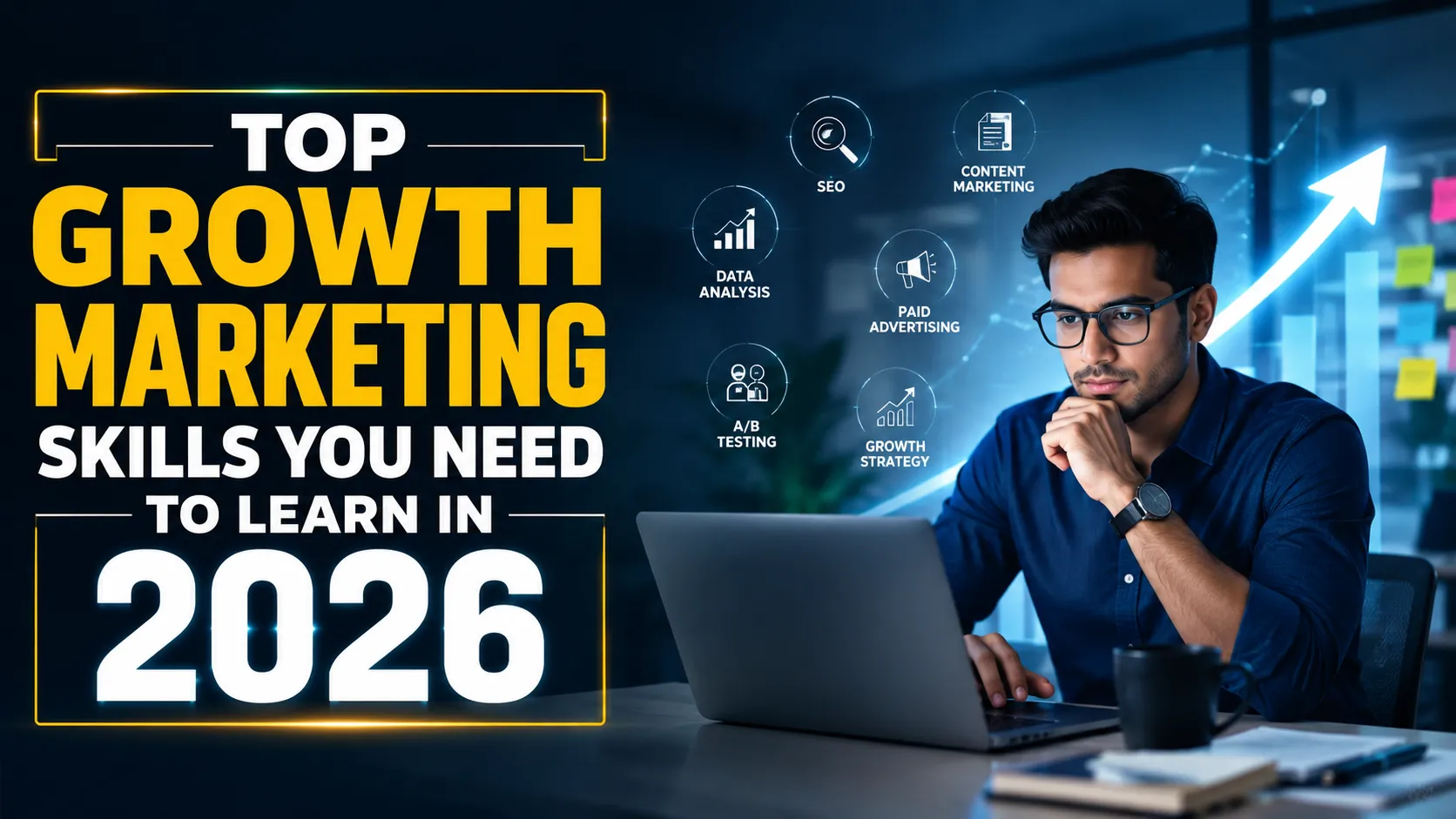
Top Growth Marketing Skills to Learn in 2026
1. Data Analytics and Marketing Measurement
If you want a career in modern marketing, learn to understand data.
You do not need to become a data scientist. However, you should be comfortable reading campaign performance, website traffic, conversion rates, engagement, customer acquisition costs, and other important metrics.
Tools such as Google Analytics 4, Google Search Console, Looker Studio, spreadsheets, and advertising dashboards can help you develop this ability.
For example, suppose an advertisement receives 20,000 impressions and 600 clicks. That sounds impressive until you discover that only five people completed the desired action.
A growth marketer does not celebrate clicks alone. They investigate the complete journey.
Students looking for digital marketing training in indore should therefore choose learning programs that include analytics and practical campaign measurement instead of focusing only on theory.
2. Customer Research and Understanding Buyer Behaviour
Great growth marketers understand people before they promote products.
Customer research helps you discover what people need, what problems they face, what objections stop them from buying, and what motivates them to take action.
You can begin with simple methods.
Read customer reviews. Study competitor websites. Observe social media comments. Conduct short surveys. Speak with potential customers. Analyze frequently searched questions.
For example, imagine a student searching for a digital marketing course in indore. They may not simply want a course. They could actually be looking for practical experience, internship opportunities, portfolio projects, placement support, or a way to become job-ready.
Understanding that difference can completely change a marketing campaign.
3. SEO and Search Intent
SEO remains an important skill for growth-focused marketers because search can bring consistent, high-intent traffic.
But modern SEO is not simply about adding keywords to an article.
You need to understand search intent, content quality, topical relevance, internal linking, technical SEO, user experience, and how people discover information through search engines and answer engines.
A beginner can start by learning how to identify four major types of intent:
Informational intent means the user wants an answer.
Navigational intent means the user is looking for a particular website or brand.
Commercial intent means the user is comparing options.
Transactional intent means the user is ready to take action.
For someone targeting students, phrases such as digital marketing internship in indore, best digital marketing course in indore, and digital marketing classes in indore can reveal strong commercial intent.
Learning how to connect search intent with useful content can make you much more valuable as a marketer.
4. Paid Advertising and Campaign Optimization
Organic marketing is powerful, but growth teams also need paid acquisition skills.
Learn the fundamentals of Google Ads, Meta Ads, campaign objectives, audience targeting, creative testing, bidding, landing pages, conversion tracking, and budget optimization.
Do not focus only on learning where to click inside an advertising platform.
Understand why a campaign works.
Suppose Campaign A generates 100 leads at ₹250 per lead while Campaign B generates 70 leads at ₹150 per lead. Campaign A has more leads, but Campaign B is more efficient.
This is where numbers become important.
A marketer should learn to compare cost, quality, conversion rate, revenue, and return rather than celebrating vanity metrics.
5. Conversion Rate Optimization
Getting visitors is only half the job.
The next question is: what happens after they arrive?
Conversion Rate Optimization, or CRO, focuses on improving the percentage of visitors who complete a desired action.
That action could be submitting a form, purchasing a product, booking a consultation, downloading a resource, or registering for an event.
Simple changes can sometimes produce meaningful results.
You can test headlines, buttons, page layouts, forms, testimonials, images, offers, pricing information, and calls to action.
A student can even practice CRO on a personal portfolio website. Create two versions of a landing page, send traffic to both, and compare the results.
That becomes a portfolio project you can discuss during an interview.
6. A/B Testing and Experimentation
Experimentation is one of the most important skills in growth-focused marketing.
Instead of saying, “I think this headline is better,” you test it.
Instead of assuming one advertisement will perform better, you compare multiple versions.
A simple experiment can follow this structure:
Problem → Hypothesis → Test → Measurement → Learning → Next Experiment
For example:
Problem: A landing page receives traffic but generates few leads.
Hypothesis: Visitors do not immediately understand the offer.
Test: Create a clearer headline and shorter form.
Measurement: Compare conversion rates.
Learning: Identify whether the change improved performance.
The goal is not to win every experiment. The goal is to learn faster.
AI and Growth Marketing: A Must-Learn Skill in 2026
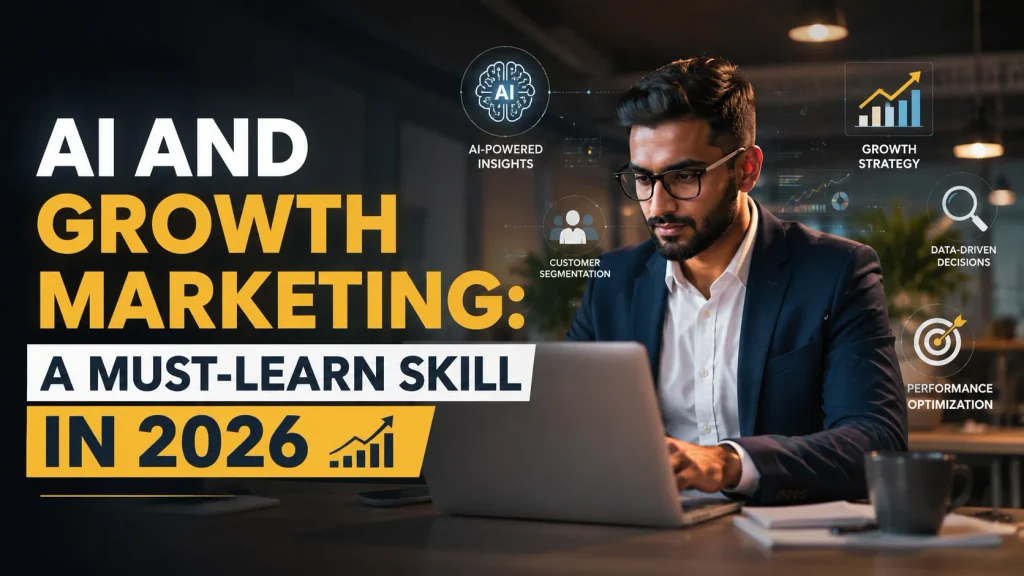
AI is changing how marketing teams research, create, analyze, personalize, and automate campaigns.
LinkedIn reported in 2025 that AI literacy was among the fastest-growing skills across regions and job functions, while its research suggested that around 70% of the skills used in most jobs could change between 2015 and 2030.
For marketers, AI can help with customer research, content ideas, competitor analysis, campaign variations, data interpretation, personalization, reporting, and workflow automation.
However, knowing how to use an AI tool is not enough.
You need to know how to give good instructions, evaluate outputs, check facts, protect customer information, and add human judgment.
The best future marketers will not compete against AI. They will learn how to work effectively with it.
Content Marketing and Storytelling
People rarely remember a list of features.
They remember stories.
That is why content creation remains an important part of Growth Marketing.
Learn how to create blogs, short-form videos, social posts, email campaigns, case studies, landing-page copy, and educational content.
Good content should answer a real question or solve a real problem.
For example, instead of writing a generic post titled “Digital Marketing Tips,” create something specific such as “7 Digital Marketing Skills Fresh Graduates Should Learn Before Applying for Their First Job.”
Specific content attracts a specific audience.
HubSpot’s 2025 marketing research also highlighted the growing use of AI to help marketers manage increasing content demands and the importance of personalization.
Email Marketing and Retention
Many beginners focus entirely on getting new customers.
Experienced growth marketers also ask how to keep existing customers engaged.
Email marketing can help businesses educate leads, nurture prospects, announce offers, share useful information, and encourage repeat purchases.
Learn the basics of segmentation, personalization, subject lines, automation, customer journeys, open rates, click-through rates, and conversions.
Retention matters because a customer who returns can be more valuable than a customer who purchases only once.
Product Thinking and User Experience
Growth does not belong only to the marketing department.
If a product is difficult to use, confusing, slow, or disappointing, excellent advertising cannot solve the entire problem.
That is why marketers should develop basic product thinking.
Understand the user’s journey from discovery to purchase and beyond.
Ask yourself:
Where does the customer become confused?
Where do they leave?
What information do they need before taking action?
What makes them return?
This approach connects marketing with product development and customer experience.
Communication and Creative Thinking
Technology alone will not make you a successful marketer.
You also need to explain ideas clearly.
A growth marketer may need to present campaign results to a manager, write a persuasive advertisement, explain customer research, collaborate with designers, or convince a team to test a new idea.
The World Economic Forum continues to rank analytical thinking highly among core employer requirements, while creative thinking, resilience, flexibility, and adaptability are also rising in importance.
So, develop both sides.
Learn the numbers.
Learn the story behind the numbers.
Growth Marketing Skills: Beginner vs Job-Ready
| Skill Area | Beginner Level | Job-Ready Level |
|---|---|---|
| SEO | Knows basic keywords | Can perform research and create an SEO plan |
| Analytics | Reads basic reports | Can identify problems and recommend actions |
| Paid Ads | Knows campaign setup | Can test, optimize, and report performance |
| Content | Can write posts | Can create content based on intent and funnel stage |
| CRO | Understands conversions | Can design and evaluate experiments |
| AI | Uses basic prompts | Uses AI responsibly for research and workflows |
| Creates newsletters | Can build segmented campaigns | |
| Strategy | Follows instructions | Can connect actions with business goals |
The difference is practice.
A Real-Life Growth Marketing Example
Imagine an online education company offering courses to college students.
The company gets 10,000 monthly website visitors but only 100 registrations.
A beginner may suggest increasing advertising.
A growth marketer investigates.
They discover that mobile visitors leave quickly because the registration page is difficult to use. They also find that students respond better to practical internship-focused messaging than generic course descriptions.
The team redesigns the mobile page, improves the offer, adds student-focused content, and runs an A/B test.
The important lesson is simple: growth often comes from fixing the journey, not just increasing traffic.
A Simple Step-by-Step Learning Roadmap
If you are starting from zero, do not try to learn everything at once.
Step 1: Learn marketing fundamentals.
Understand customer journeys, funnels, positioning, offers, branding, and basic digital channels.
Step 2: Learn SEO.
Practice keyword research, search intent, on-page optimization, technical basics, and content strategy.
Step 3: Learn analytics.
Become comfortable with GA4, Search Console, spreadsheets, and campaign reports.
Step 4: Learn paid advertising.
Build sample Google Ads and Meta Ads campaigns and understand their metrics.
Step 5: Learn CRO and testing.
Create landing pages and test different headlines, layouts, and calls to action.
Step 6: Learn AI workflows.
Use AI for research, brainstorming, analysis, content assistance, and repetitive marketing tasks.
Step 7: Build projects.
Do not stop at certificates. Create campaigns, reports, landing pages, SEO plans, and case studies.
Step 8: Get practical experience.
An internship can give you exposure to real campaigns, deadlines, clients, tools, and teamwork.
Students searching for internship training courses should prioritize programs where they can actually work on projects rather than only watching recorded lessons.
How to Build a Growth Marketing Portfolio
Your portfolio can be more powerful than a resume filled with course names.
Create three to five practical projects.
You could conduct an SEO audit for a local business.
You could create a paid advertising strategy for a fictional startup.
could redesign a landing page and explain your CRO hypothesis.
You could prepare a social media growth plan.
You could analyze a website using publicly available information and suggest improvements.
If you are searching for a best internship company in indore, look for opportunities where you can contribute to real projects and turn your work into measurable portfolio evidence.
The goal is to show what you can do, not simply what you have studied.
Career Opportunities After Learning These Skills
A strong skill combination can open pathways into roles such as Growth Marketing Executive, Digital Marketing Executive, SEO Executive, Performance Marketing Executive, Content Marketing Executive, Marketing Analyst, Social Media Executive, CRM Executive, and Growth Associate.
For students comparing the best digital marketing institute in indore, top digital marketing institute in indore, or best digital marketing course in indore, look beyond advertisements.
Check whether the program teaches practical tools, live projects, analytics, SEO, paid advertising, AI, conversion optimization, and campaign reporting.
A good learning environment should help you move from “I know this concept” to “I can actually do this.”
Common Mistakes Beginners Make
The first mistake is collecting certificates without building projects.
The second is focusing on followers instead of business outcomes.
The third is learning tools without understanding marketing fundamentals.
Another common mistake is copying competitors without understanding their audience.
Some beginners also try to master ten platforms at once. That usually creates shallow knowledge.
Instead, become strong in a few connected skills and gradually expand.
Practical Solutions for Faster Skill Development

Spend less time passively watching tutorials.
Use a 30-30-30 learning method.
Spend 30% of your time learning concepts.
30% practicing with tools.
30% building projects and reviewing results.
The remaining time can be used for reading industry updates, analyzing campaigns, or discussing your work with experienced marketers.
If you are considering digital marketing training in indore, ask yourself a simple question before enrolling:
“Will I finish this program with something I can show an employer?”
If the answer is no, reconsider your choice.
2026 Growth Marketing Trends to Watch
Several trends are shaping the marketing industry.
AI-assisted marketing is becoming more common.
First-party data is becoming increasingly important.
Personalization is moving toward more contextual customer experiences.
Search is becoming more diverse, with people discovering information through traditional search engines, social platforms, marketplaces, and AI-powered interfaces.
Experimentation is becoming more important as companies look for efficient ways to grow.
Marketing teams are also becoming more data-driven.
This means future marketers will need a combination of creativity, technology, customer understanding, and analytical thinking.
Growth Marketing Skills Checklist for Students
- Learn customer research and buyer behaviour.
- Understand SEO and search intent.
- Practice Google Analytics and reporting.
- Learn paid advertising fundamentals.
- Understand conversion optimization.
- Practice A/B testing.
- Learn email marketing.
- Build content and storytelling skills.
- Learn practical AI workflows.
- Understand basic UX and product thinking.
- Create three to five portfolio projects.
- Complete a practical internship.
Frequently Asked Questions
Is Growth Marketing a good career for freshers?
Yes. It can be a strong career path for freshers who enjoy creativity, data, experimentation, technology, and problem-solving. Practical projects can help candidates demonstrate their abilities even when they have limited professional experience.
What should I learn first?
Start with marketing fundamentals, customer research, SEO, analytics, content, and paid advertising. Once you understand these foundations, move into CRO, experimentation, automation, and AI.
Do I need coding skills?
Not necessarily. Basic technical knowledge can be helpful, especially for analytics, websites, tracking, and automation, but you do not need to become a professional programmer to begin a marketing career.
Is an internship useful for learning these skills?
Absolutely. A practical digital marketing internship in indore can help you understand how marketing works in a real environment. It can also give you projects that strengthen your resume and portfolio.
Which course should students choose?
Look for practical best internship courses or marketing programs that combine concepts with projects, tools, analytics, campaign execution, and industry exposure. Do not choose a course only because it claims to be the “best.”
Final Thoughts: Start Building, Not Just Learning
The biggest mistake a student can make in 2026 is waiting until graduation to become job-ready.
Start now.
Learn one skill.
Build one project.
Analyze one campaign.
Improve it.
Then repeat.
If you are searching for digital marketing classes in indore, digital marketing training in indore, or practical internship training courses, focus on learning environments that encourage real work and measurable outcomes.
For students, fresh graduates, job seekers, and career starters, the goal should not be to know every marketing tool.
The goal is to become someone who can look at a business problem and say, “Let me find out what is happening, test a solution, and measure the result.”
That is the mindset that makes Growth Marketing valuable in 2026.
If you are ready to turn marketing knowledge into practical experience, explore the learning and internship opportunities available at TheInternspire and start building skills that you can confidently demonstrate to future employers.
Quick Question for You
If you had 30 days to prove your marketing ability to an employer, what would you build: an SEO project, paid advertising campaign, landing page experiment, or complete growth strategy?
Choose one.
Build it.
Measure it.
Put it in your portfolio.
That first project could be the beginning of your marketing career.
Explore practical learning opportunities with TheInternspire and take the next step toward becoming job-ready.
Sources: World Economic Forum, Future of Jobs Report 2025; LinkedIn, Skills on the Rise 2025; HubSpot, State of Marketing 2025.