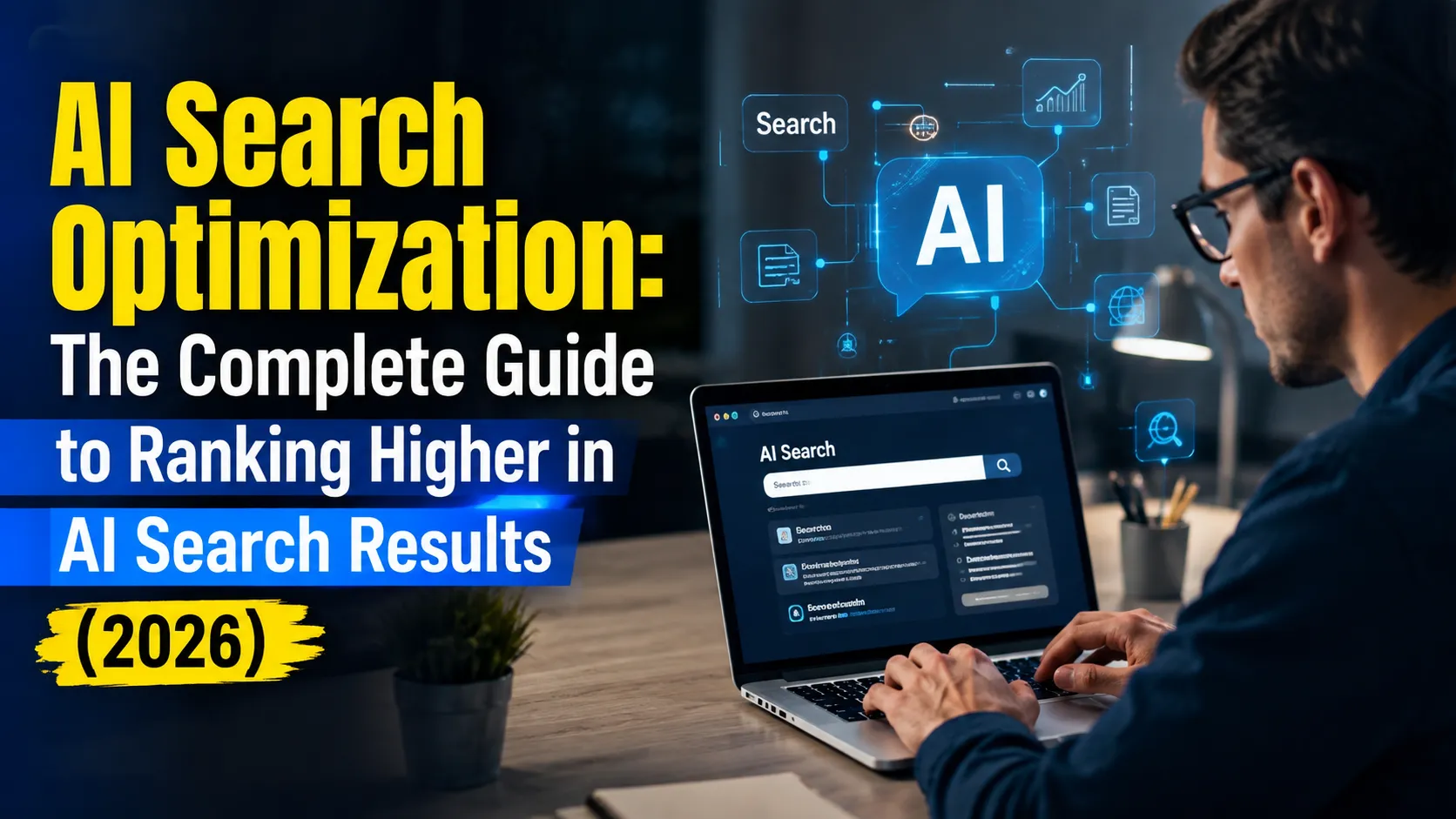
When Search Is No Longer Just About Blue Links
AI Search Optimization is changing how websites, businesses, students, creators, and professionals think about online visibility.
Imagine a final-year student searching, “What is the best digital marketing career for a fresher in Indore?”
Earlier, the student would see a list of websites and choose a few results to visit. Today, AI-powered search can understand the question, break it into related topics, summarize information, compare options, and provide links to supporting websites.
That changes the game.
Google says AI Overviews now reach more than 2.5 billion monthly active users, while AI Mode has surpassed 1 billion monthly users. Google has also reported that AI Mode queries have more than doubled every quarter since launch.
For students and fresh graduates, this creates an important opportunity.
If your portfolio, internship profile, blog, LinkedIn content, or personal website provides useful and trustworthy information, AI search systems may discover and reference it.
The goal is no longer simply to rank for one keyword.
The goal is to become a useful source that search engines and AI systems can understand, trust, and recommend.
What Is AI Search Optimization?
AI Search Optimization means creating and improving online content so that search engines and AI-powered search experiences can understand, evaluate, and potentially reference it when answering users’ questions.
It connects traditional SEO with a more conversational search experience.
Google explains that AI Overviews and AI Mode can use a technique called “query fan-out,” where related searches are performed across different subtopics and sources to build a response.
For example, someone may search:
“Which best digital marketing course in Indore should a fresher choose?”
An AI-powered search experience may consider several related questions:
- Which courses teach practical skills?
- Does the course include internships?
- Is placement support available?
- What skills are currently useful?
- Which institutes have relevant training?
- What do students need before joining?
This is why creating useful, complete content matters more than repeatedly inserting the same keyword.
Why AI Search Optimization Matters in 2026
Search behavior is becoming more conversational.
People are asking longer questions instead of typing only two or three words. Google says AI Mode is particularly useful for complex questions, comparisons, exploration, and follow-up queries.
This matters for career-focused websites.
A student may not search only for “digital marketing course.”
They may ask:
“Which digital marketing course in Indore is suitable for a graduate with no technical background?”
That question contains intent, context, location, and a specific problem.
A strong website should answer all four.
Google also states that there are no special technical requirements or separate AI-only schema required for appearing in AI Overviews or AI Mode. Existing SEO fundamentals remain important.
So, you do not need to forget SEO.
You need to make SEO more useful.
AI Search Optimization and Traditional SEO: What Has Changed?
Traditional SEO often focuses on rankings, keywords, backlinks, technical SEO, and organic clicks.
AI-powered search adds another layer: being understood and referenced as a useful source.
| Traditional SEO | AI Search Optimization |
|---|---|
| Focuses heavily on rankings | Focuses on visibility and references |
| Targets keywords | Targets questions and search intent |
| Optimizes individual pages | Builds topic depth and authority |
| Often targets short queries | Answers conversational queries |
| Measures rankings and traffic | Also considers mentions, citations and visibility |
| Depends on search-result clicks | Can influence discovery inside AI answers |
The two approaches should not be treated as competitors.
They work together.
Google specifically says the same foundational SEO practices remain relevant for AI features.
How AI Search Optimization Can Help Students and Freshers
You may be wondering:
“What does this have to do with my career?”
A lot.
Suppose you are learning digital marketing and create a personal website where you publish practical articles about SEO, Google Ads, content marketing, analytics, and AI tools.
Instead of writing generic articles, you answer real questions such as:
“How can a fresher build an SEO portfolio?”
“What should I learn before applying for a digital marketing internship in Indore?”
“What projects should a student add to a digital marketing resume?”
Over time, this content can demonstrate your knowledge.
When applying for an internship, you can share those articles with recruiters.
Your website becomes more than a resume.
It becomes proof of your skills.
Step-by-Step AI Search Optimization Strategy
1. Start With Real Questions
Do not begin with keywords alone.
Begin with questions your audience actually asks.
For example, a student searching for best internship courses may also want to know:
Which course is beginner-friendly?
Does it provide practical projects?
Is there internship experience?
What skills will I learn?
Can it help with placement?
Turn these questions into sections, FAQs, articles, and supporting pages.
This gives your content natural depth.
2. Build Topic Clusters
One article is rarely enough to establish strong topical coverage.
Suppose your primary topic is digital marketing.
You could create supporting content around:
- SEO for beginners
- Google Ads
- Social media marketing
- Content marketing
- Analytics
- AI tools for marketers
- Digital marketing careers
- Internship preparation
- Resume building
For local intent, related content can naturally discuss digital marketing training in Indore, digital marketing classes in Indore, and career opportunities available to students.
Then connect these pages using internal links.
Google recommends making important content easily discoverable through internal linking.
3. Answer the Question Quickly
AI-friendly content should not hide the answer under five paragraphs of introduction.
Start with a direct answer.
For example:
“AI Search Optimization is the process of improving content so search engines and AI-powered search experiences can understand, trust, and potentially reference it.”
Then explain the topic.
This structure helps readers and makes your content easier to understand.
Use short paragraphs.
Use descriptive headings.
Add examples.
Use tables when comparisons are useful.
4. Add First-Hand Experience
This is one of the strongest ways to make content different from generic AI-generated articles.
Instead of saying:
“Digital marketing is a growing field.”
Explain what you observed while working on a campaign.
For example:
A student creates a small website, researches keywords, publishes five useful articles, improves internal links, and tracks performance in Search Console.
That is more valuable than another generic definition of SEO.
Google’s guidance emphasizes unique, satisfying, people-first content rather than content created simply to manipulate search rankings.
Create Content That AI Search Can Understand
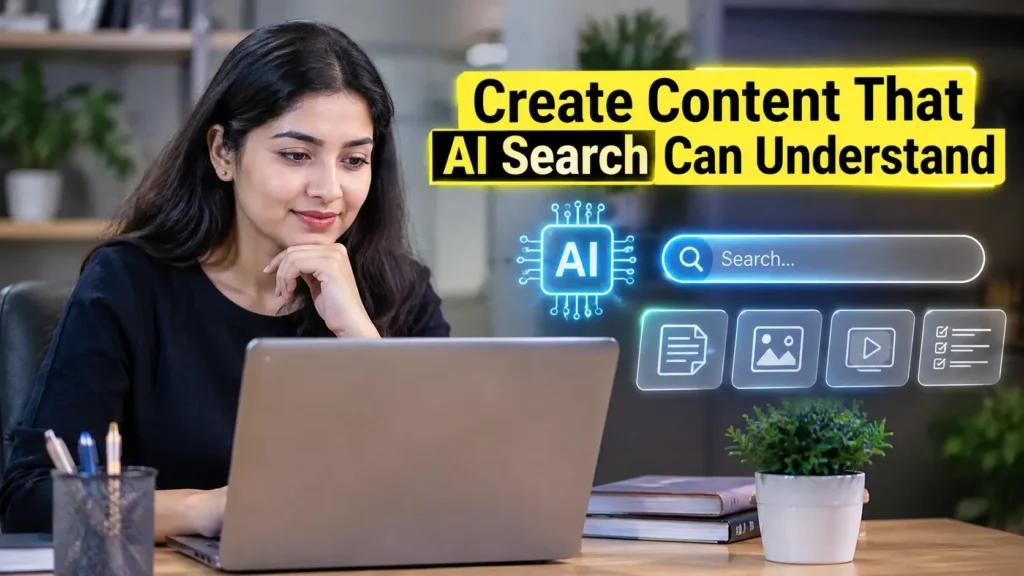
Clear structure matters.
Consider an article titled:
“Top digital marketing institute in Indore: What Students Should Check Before Joining.”
A strong article could answer:
What should beginners learn?
How much practical work is included?
Are internships available?
Is placement guidance provided?
Does the program include SEO and analytics?
What should students ask before enrolling?
This naturally covers multiple search intents without stuffing the same phrase repeatedly.
The same principle works for a best digital marketing institute in Indore comparison article.
Give readers useful evaluation criteria instead of simply declaring one institute “best.”
That creates more trustworthy content.
Use Entity and Brand Signals Naturally
AI systems need context.
Your website should clearly communicate:
Who you are.
What you teach.
Where you operate.
Who your audience is.
What expertise you provide.
What services or courses you offer.
For example, a page discussing digital marketing training near me should clearly explain the location, training format, curriculum, practical learning, and student outcomes.
Do not force keywords into every sentence.
Build a recognizable topic and brand around them.
Build Strong Internal Links
Imagine a student lands on an article about SEO.
From that page, they should be able to discover related resources about:
SEO courses.
Digital marketing internships.
Google Ads.
Content marketing.
Resume preparation.
Career opportunities.
Your internal linking structure helps visitors move naturally through your website.
It also helps search engines discover related pages.
Think of internal links as roads connecting different parts of your website.
Earn Mentions and Quality Backlinks
Content visibility does not happen in isolation.
Create genuinely useful resources that other websites would want to reference.
For example:
“Digital Marketing Skills Checklist for Freshers”
“SEO Interview Questions for Beginners”
“Digital Marketing Career Roadmap for 2026”
“Student Guide to Building a Marketing Portfolio”
You can promote these through relevant educational websites, professional communities, guest contributions, industry publications, and legitimate partnerships.
Avoid mass-produced backlinks.
One relevant mention can be more useful than dozens of unrelated links.
Real-World Example: From Student to Searchable Professional
Consider a fictional but realistic example.
Rahul is a final-year graduate who wants a career in digital marketing.
Instead of only completing a course, he builds a simple portfolio website.
He publishes an article explaining keyword research.
Then he creates a practical SEO case study.
Next, he writes about preparing for a digital marketing internship near me and documents the skills he learned.
He adds screenshots, explanations, lessons, and results where appropriate.
After several months, Rahul has something more powerful than a certificate.
He has evidence.
When a recruiter searches his name, there is useful work associated with him.
That is personal search visibility.
Case Study: How Google Is Expanding AI Search
Google’s own AI Search developments show why this area deserves attention.
In May 2026, Google announced improvements designed to connect users with more relevant websites, deeper articles, original content, and firsthand perspectives through AI Overviews and AI Mode.
Google has also introduced a “Highly Cited” badge and expanded Preferred Sources into AI Search experiences. Google reported that users were twice as likely to click through to Preferred Sources in its testing.
The lesson is simple:
Original, useful and recognizable sources can become increasingly valuable in AI-powered discovery.
Statistics That Show Where Search Is Going
The numbers make the shift difficult to ignore.
Google reported in 2026 that AI Overviews had more than 2.5 billion monthly active users. AI Mode had surpassed 1 billion monthly users.
Google also reported that AI Mode queries had more than doubled every quarter since launch.
In another update, Google said AI Overviews and AI Mode were helping drive more Search usage, with AI Overviews increasing Google usage by more than 10% for the types of queries where they appear in major markets including India and the U.S.
These numbers show why marketers, students, entrepreneurs and career starters should understand AI-powered search.
How to Measure AI Search Optimization
Do not measure success only by one keyword position.
Track:
Organic impressions.
Organic clicks.
Search queries.
Engagement.
Conversions.
Leads.
Branded searches.
Referring pages.
Content visibility.
AI-related search visibility where available.
Google announced new Search Console reporting for generative AI features in June 2026, including dedicated views for visibility in AI Overviews and AI Mode, initially rolling these reports out to a subset of websites.
Bing has also introduced AI Performance insights in Webmaster Tools, showing how publisher content appears across Microsoft Copilot, Bing AI-generated summaries, and selected partner experiences.
That means measurement is moving beyond traditional rankings.
AI Search Optimization Checklist for 2026
Before publishing an article, ask yourself:
Does the article answer a real question?
Is the introduction clear?
Is the main answer easy to find?
Does the article contain original insights?
Have I included relevant examples?
Are statistics supported by trustworthy sources?
headings descriptive?
Are related topics internally linked?
Is the content written for people rather than algorithms?
Are important details available as text?
Does the page load properly?
Are images useful and properly described?
Does structured data match visible content?
Is the author or organization clearly identified?
Does the article provide something competitors do not?
Google specifically recommends ensuring important content is available in textual form, using internal links, providing good page experience, and making structured data consistent with visible content.
Common AI Search Optimization Mistakes
Keyword Stuffing
Repeating digital marketing course in Indore twenty times will not automatically make an article stronger.
Write naturally.
Creating Generic AI Content
AI can help with research and brainstorming.
But publishing shallow content with no original value makes your website easier to ignore.
Ignoring Search Intent
A person searching “SEO interview questions” wants something different from someone searching “SEO course in Indore.”
Understand the reason behind the query.
Writing Only for Search Engines
If a reader cannot understand your article quickly, optimization has failed.
Ignoring Local Context
For a local training website, phrases such as digital marketing classes in Indore should be supported by real local information, course details, student needs, and useful guidance.
Chasing a Special “AI Schema”
Google currently says there is no special AI schema or separate AI-only markup required for eligibility in AI Overviews or AI Mode.
Focus on strong SEO fundamentals instead.
Practical AI Search Optimization Plan for Students
If you are a college student, start small.
1: Choose one career topic and research 20 questions people ask about it.
2: Create one detailed article answering the most important questions.
3: Publish two supporting articles and connect them with internal links.
4: Build a practical project and turn your experience into a case study.
Then promote your content through legitimate channels.
If you are learning through internship training courses, use every project as an opportunity to create something you can demonstrate publicly.
Your objective is not to become famous overnight.
Your objective is to become findable, useful and credible.
What AI Search Means for Careers in 2026
AI is not only changing how people find information.
It is changing what employers expect from digital professionals.
A modern fresher should understand:
SEO.
Content strategy.
Search intent.
Analytics.
AI tools.
Research.
Prompting.
Content optimization.
Digital branding.
Basic data interpretation.
Someone who knows how to create content is useful.
Someone who understands why content gets discovered, referenced, clicked and converted is even more valuable.
That is why learning AI-powered search alongside digital marketing can give students a practical advantage.
Frequently Asked Questions
What is AI Search Optimization?
It is the process of improving content, website structure, authority and user experience so AI-powered search systems can understand and potentially reference your website when answering relevant questions.
Is AI Search Optimization replacing SEO?
No. Google states that foundational SEO remains important for AI Overviews and AI Mode.
Think of it as an evolution of search visibility rather than a complete replacement for SEO.
Can freshers learn AI Search Optimization?
Absolutely.
Start with keyword research, search intent, content writing, technical SEO, internal linking, analytics and AI tools.
Does AI-generated content rank?
Using AI does not automatically guarantee visibility.
The important question is whether the final content is useful, accurate, original and valuable to readers.
Should students create personal websites?
Yes, especially if they want to demonstrate practical skills.
A portfolio can showcase projects, articles, certifications, internships and measurable work.
Is local SEO still important?
Yes.
For searches related to education, training and services, location can be an important part of user intent. Content around digital marketing training in Indore should provide genuine local information rather than simply repeating the location keyword.
The Future of AI Search Optimization
Search is moving from:
“Find me a website.”
toward:
“Understand my question and help me make a decision.”
That is the biggest shift marketers and students need to understand.
The winners will not necessarily be the websites with the most keywords.
They will be the websites that provide clear answers, original experiences, useful data, trustworthy information and strong topical depth.
For a student, this creates an exciting opportunity.
You do not need ten years of experience to start building online authority.
You can start with one useful article.
Then one project.
one case study.
Then one portfolio.
Over time, these small pieces can create a strong digital footprint.
Final Takeaway: Become the Source AI Search Wants to Find
AI Search Optimization is ultimately about one simple idea:
Create something genuinely useful enough that both people and search systems understand its value.
If you are a final-year student, start building your knowledge now.
If you are a fresher, turn your learning into public projects.
searching for best internship company in Indore, do not only look for a certificate. Look for practical exposure.
If you are comparing best digital marketing institute in Indore, evaluate curriculum, projects, mentorship, internship opportunities and career support.
And if you are planning to join a digital marketing internship in Indore, use the experience to build evidence of what you can actually do.
The future of search will continue to evolve.
Your career can evolve with it.
Want to become job-ready in digital marketing and learn practical SEO, AI tools and industry skills? Explore The Internspire’s training and internship opportunities and start building skills that employers can see.